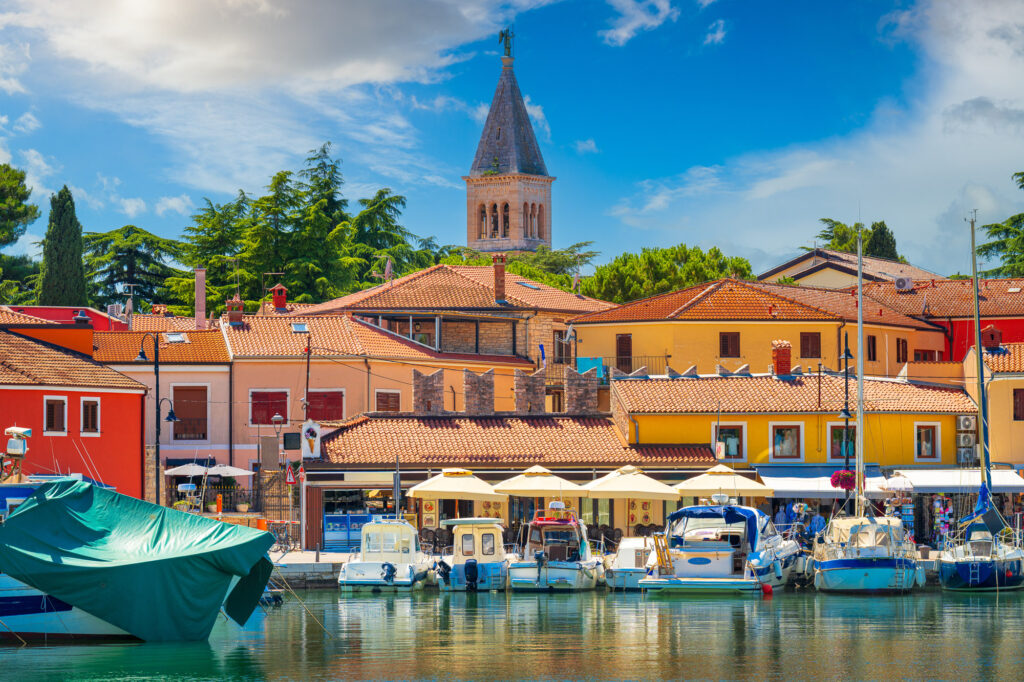
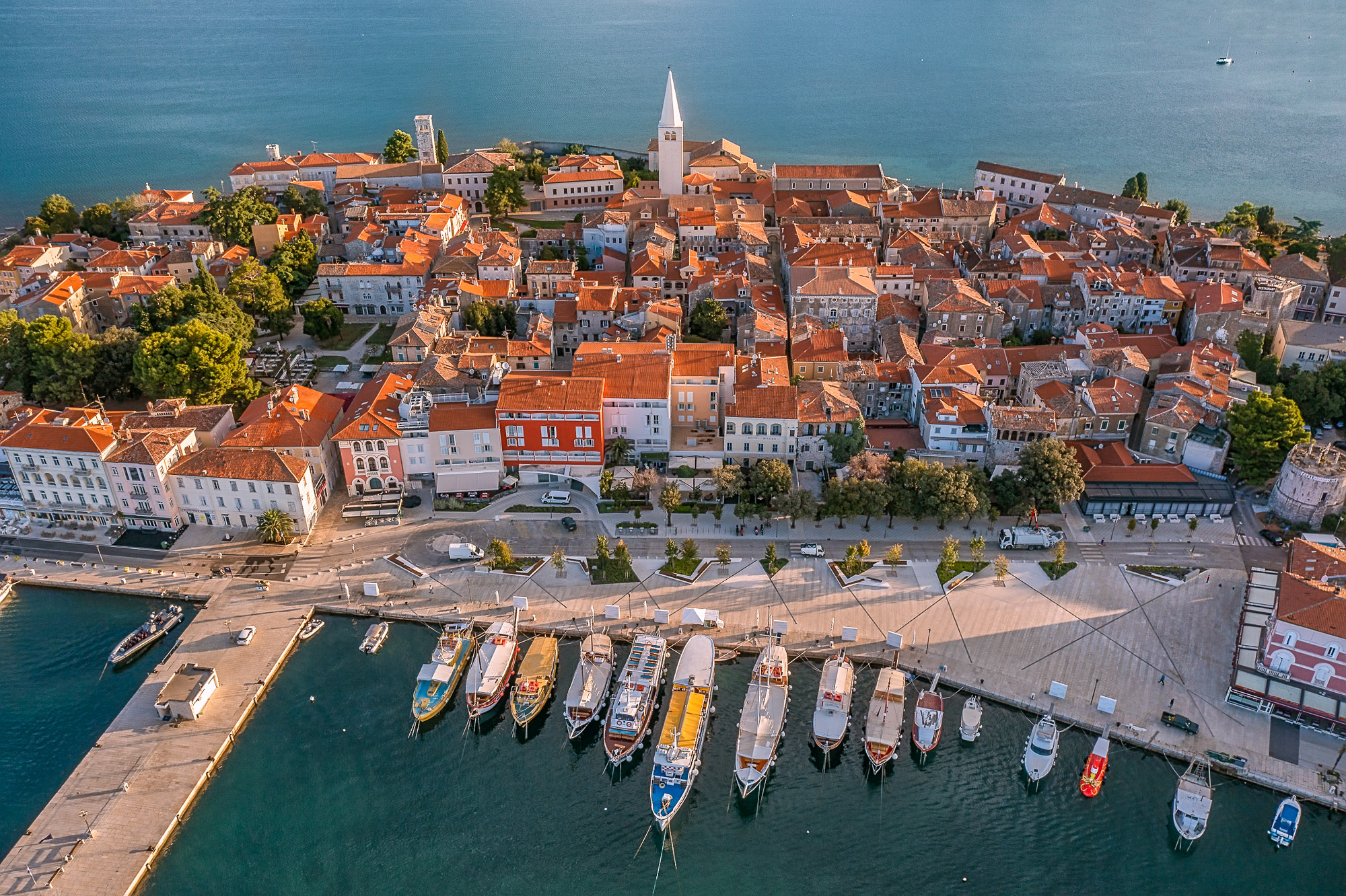
Poreč is one of the most useful places to understand western Istria because its appeal is broader than a summer beach destination. The historic centre preserves Roman and Venetian layers, the Euphrasian Basilica is a UNESCO World Heritage site, and the coast immediately around town offers a long choice of swimming areas and resort beaches.
This guide focuses on what is actually useful when planning a visit: what to see in the old town, how much time to allow, where the main beach areas are, when to visit, how Poreč works as a base for Istria, and what to know before arriving by car.
Why visit Poreč?
Poreč works particularly well for travelers who want several different types of holiday in one place. You can spend a morning walking through a compact historic centre, visit one of Istria’s most important early Christian monuments, and still reach the coast without a long transfer.
The town is also practical for exploring western Istria. It sits between other coastal destinations and the inland towns of central Istria, so a stay here can work as a base rather than requiring a new hotel every night.
Poreč Old Town
The historic centre occupies a peninsula and retains the Roman street layout known as the Decumanus and Cardo. Later Venetian buildings sit alongside much older remains, making the old town more interesting when you look at it as a layered urban landscape rather than as a collection of isolated monuments.
Decumanus and Cardo
The main historic streets are an easy way to orient yourself. Decumanus runs through the old centre and connects several of the places visitors naturally want to see. Walking these streets slowly is more rewarding than trying to cover the centre only by following a sightseeing checklist.
Roman and Venetian Poreč
Poreč was developed as the Roman colony of Colonia Iulia Parentium, and the present city still reflects that ancient foundation. Centuries of Venetian rule added palaces, urban details and a distinctive Adriatic character.
The result is a town where Roman planning, medieval structures and Venetian architecture are often encountered within a short walk.
The Euphrasian Basilica: Poreč’s most important sight
The Euphrasian Basilica is the landmark that should be at the top of a first visit. The complex was developed in the 6th century under Bishop Euphrasius and includes the basilica, atrium, baptistery and former episcopal buildings.
The complex has been on the UNESCO World Heritage List since 1997. Its mosaics are particularly significant, and the building is one of the strongest reasons to visit Poreč even if you are not primarily interested in religious architecture.
Current visitor arrangements can vary by season and around religious services, so check the official information before your visit. The bell tower also provides a different perspective over the town when access is available.
What to see and do in Poreč
- Walk the Roman-era street network through the old town.
- Visit the Euphrasian Basilica and its mosaic-covered complex.
- Explore the waterfront and the harbour.
- Look for Venetian architecture around the historic centre.
- Spend time at one of the coastal beaches south or north of the centre.
- Use Poreč as a starting point for cycling and coastal excursions.
- Plan a day trip to an inland Istrian hill town.
Poreč beaches
Poreč has a coastline suited to travelers who prefer variety rather than one large sandy beach. Much of the coast is rocky, paved or gently landscaped, with pine-covered areas providing shade and resort facilities in many locations.
Gradsko kupalište
Gradsko kupalište is an urban beach area about 1 km south of the centre. The coast is around 1.3 km long and includes rocky sections and coves. The official Istria tourism information lists lifeguards, first-aid facilities, sports facilities, showers and other services during the season.
Brulo
Brulo is a practical choice if you want to combine swimming with a greener setting. The beach area is surrounded by pine, cypress and oak trees and includes rocky, paved and grassy sections. It is also connected with the wider coastal recreation area south of Poreč.
Beaches around Poreč
The wider Poreč area has a large number of maintained beaches, including resort and camping beaches. The 2026 Blue Flag list includes several Poreč beaches, among them Špadići-Materada, Donji Špadići, Gradsko kupalište, Bellevue and a number of beaches in the Plava Laguna and Valamar areas.
This makes Poreč a good choice for travelers who would rather choose their beach based on shade, access, facilities or atmosphere than search for one universally “best” beach.
How long do you need in Poreč?
One full day is enough for a first look at the old town and the Euphrasian Basilica, with time left for a meal and a walk along the waterfront.
Two or three nights are more useful if you want to include beach time. A longer stay becomes worthwhile if you plan day trips around Istria, cycle along the coast or prefer to explore without rushing between destinations.
When is the best time to visit Poreč?
Late spring and early autumn are good choices if sightseeing is as important to you as swimming. Temperatures are generally more comfortable for walking, while the coastal infrastructure remains active.
Summer is the natural choice for a classic beach holiday, but it is also the busiest period. If you are driving, planning your arrival and parking in advance becomes more important.
Poreč also has a substantial events calendar outside the main summer months. The city is actively promoting autumn sports, cultural and gastronomic events in 2026, reinforcing its role as more than a seasonal beach destination.
Getting to Poreč
Poreč is primarily a road-access destination. For travelers flying into Istria, Pula Airport is the main Croatian airport to consider, while northern Italy and Slovenia can also be relevant depending on your route.
Once you are in western Istria, the town’s position makes it convenient for combining coastal and inland stops. If you are planning a road trip, avoid trying to visit every major Istrian destination from a single base on consecutive days; choose a few that fit naturally together.
Parking in Poreč
If you arrive by car, plan to leave the vehicle outside the historic core and continue on foot. The old town is compact and is best experienced walking rather than trying to navigate its narrow streets by car.
Parking rules, tariffs and seasonal arrangements can change, so use current municipal information and the signs at the car park on the day of your visit rather than relying on an old travel article. The City of Poreč maintains current municipal information and official notices online.
Is Poreč good for families?
Yes. Poreč offers an easy combination of historic sightseeing, beaches and outdoor activities. The coast has many locations with developed access and services, while the old town is compact enough for a manageable family walk.
For families with very young children, choose the beach based on the specific access, shade and facilities you need rather than assuming all Poreč beaches have the same conditions.
Is Poreč good for couples?
Poreč suits couples who want a flexible Istrian holiday. The old town provides an atmospheric evening setting, while the surrounding coast gives you plenty of options for swimming, walking and cycling during the day.
It is also a useful base if you want to combine a coastal stay with inland wine, food and hill-town experiences.
What to eat in Poreč
Poreč is a good place to explore the wider Istrian food tradition. Look for seasonal seafood, local olive oil, fresh pasta, truffles when in season, Istrian prosciutto and regional wines.
For the best experience, treat the town as an entry point into Istrian gastronomy rather than limiting yourself to restaurants directly beside the waterfront. Inland producers and small towns can be an important part of the food experience.
Poreč as a base for exploring Istria
Poreč is particularly useful when you want a coastal base with reasonable access to both northern and central Istria. A sensible itinerary can combine Poreč with Motovun and Grožnjan for the inland hill-town side of the peninsula, while Pula gives you a very different urban and Roman heritage experience.
For a longer stay, consider choosing one inland day and one southern Istria day rather than changing accommodation repeatedly.
Where to stay in Poreč
The right area depends on what you want from the trip. Staying close to the historic centre is convenient for evening walks, restaurants and sightseeing. Coastal resort areas are more practical if your priority is swimming, family facilities and spending much of the day outside the centre.
If you are using Poreč as a base for day trips, check parking availability at the accommodation before booking. A property that is slightly farther from the centre can be more convenient if it provides reliable parking and easy road access.
Practical Poreč travel tips
- Visit the Euphrasian Basilica early in your itinerary rather than leaving it to the final hours of your trip.
- Wear comfortable shoes for the historic centre.
- Do not assume every Poreč beach has the same surface or facilities.
- If driving in summer, decide where you will park before arriving in the centre.
- Check current attraction opening information, especially outside peak season.
- Use Poreč as a base if you prefer returning to the coast each evening.
- Combine the town with at least one inland Istrian destination for a more complete picture of the region.
Is Poreč worth visiting?
Poreč is worth visiting if you want more than a beach resort. Its strongest combination is the compact historic centre, the exceptional Euphrasian Basilica, an extensive choice of coastal areas and a location that works well for exploring western and central Istria.
For a short trip, focus on the old town and basilica. For a longer stay, add beach time and one or two carefully chosen excursions. That approach gives you a better sense of Poreč without turning the visit into a checklist of attractions.
Explore more of Istria
Planning more than one stop? These guides cover towns that combine well with Poreč:
Plan your trip
Planning a trip to Poreč?
Discover beaches, things to do, parking, food and practical travel information.