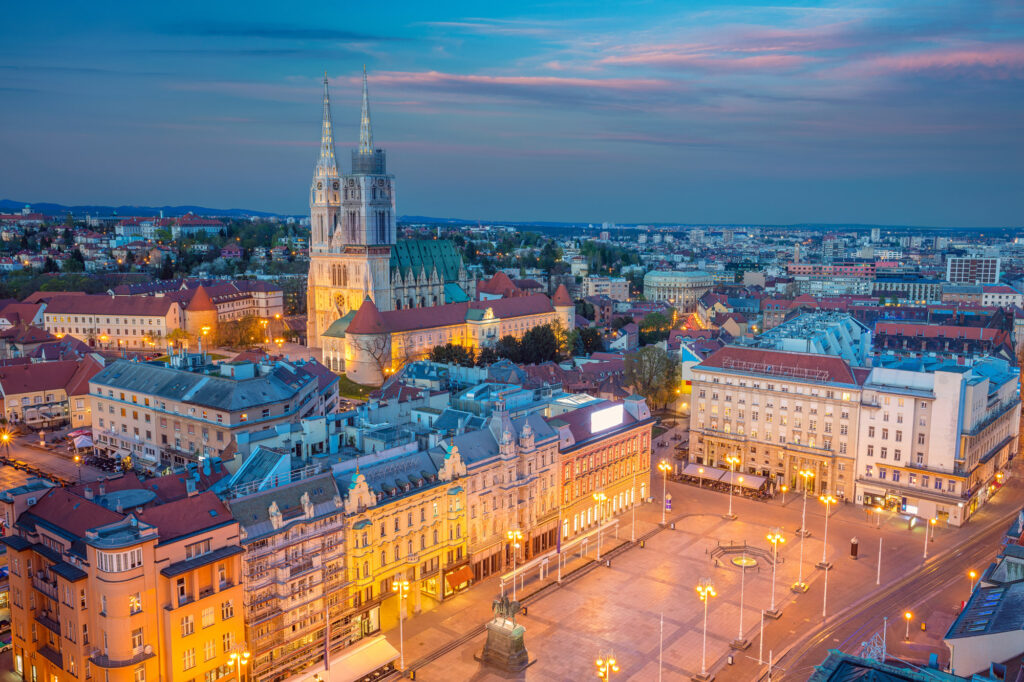
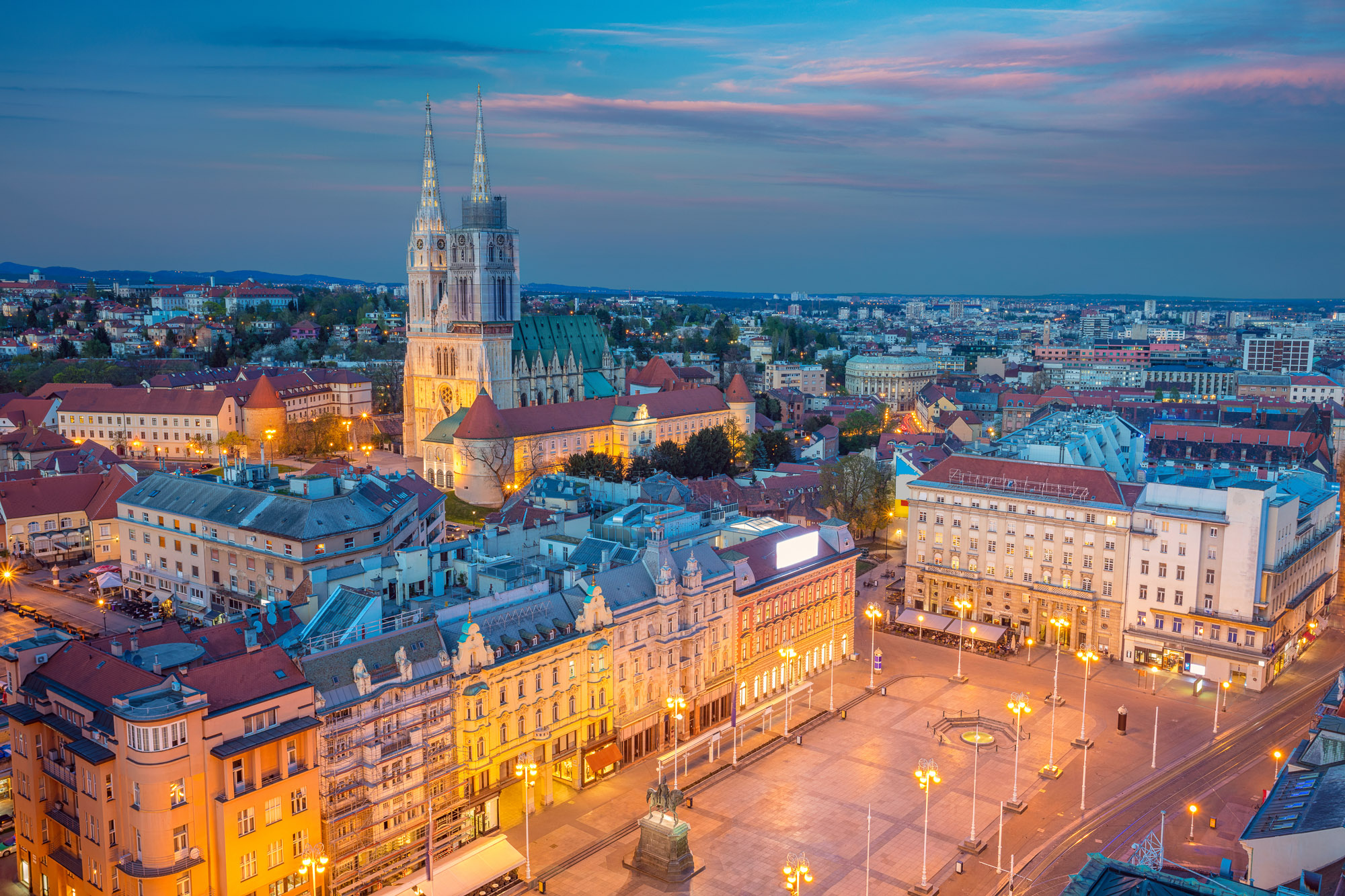
Zagreb and Central Croatia cover the capital and the green, hilly country around it: castles and spa towns in Hrvatsko Zagorje, baroque Varaždin, river-town Karlovac, Samobor’s cake-and-hiking weekends and, two hours south, Plitvice Lakes. It is the part of Croatia that works in every season, and it is the natural start or finish for most trips because Zagreb has the country’s main airport, rail and bus connections.
What the region covers
For travel planning, “Central Croatia” means the inland area within roughly two hours of Zagreb. Distances are short and the A1, A2 and A4 motorways make most places easy to reach:
- Zagreb – the capital, with its medieval Upper Town, 19th-century Lower Town and Medvednica mountain on the northern edge.
- Hrvatsko Zagorje – rolling hills north of Zagreb with castles, vineyards, pilgrimage churches and thermal spas, 45 minutes to 1 hour 15 minutes away.
- Varaždin – a compact baroque town about an hour north-east on the A4.
- Samobor – a small town about 30 minutes west, at the foot of the Samobor hills.
- Karlovac – a fortress town on four rivers, about 45 minutes south-west on the A1.
- Plitvice Lakes – Croatia’s best-known national park, about 2 hours south by car. Strictly it lies in Lika, but almost every inland itinerary pairs it with Zagreb.
This guide does not try to cover everything. It focuses on the places most visitors actually combine, in a realistic order, with honest notes on what each is like.
Zagreb: how to spend your time in the capital
Zagreb is a walkable city of around 800,000 people with a café culture that is the real point of a visit. Locals spend Saturday mornings on “špica”, the coffee-and-people-watching ritual around Flower Square (Cvjetni trg), Bogovićeva and Preradovićeva streets. Join them, and you will understand the city better than from any museum.
Upper Town (Gornji Grad)
The Upper Town is the historic core, formed from two medieval settlements: Kaptol, the church town around the cathedral, and Gradec, the civic town on the next hill. A good walking order:
- Start at Ban Jelačić Square, the main square, and walk up to Dolac Market. Come in the morning for the red umbrellas, fruit and vegetables upstairs, and cheese, cream and meat in the covered hall below.
- Continue to Zagreb Cathedral on Kaptol. It has been under long-term restoration since the 2020 earthquake, so expect scaffolding and limited access.
- Walk along Tkalčićeva Street, a former stream bed now lined with bars and cafés, then climb to the Stone Gate, a small chapel inside the old town gate where locals light candles.
- Reach St Mark’s Square with the church whose tiled roof shows the coats of arms of Zagreb and the old kingdom. The Croatian Parliament and government buildings stand on either side.
- Finish at Lotrščak Tower and the Strossmayer Promenade for a view over the Lower Town. A cannon is fired from the tower every day at noon. Take the short funicular down to Ilica, or walk the steps.
Lower Town (Donji Grad)
The Lower Town is laid out around the “Green Horseshoe”, a U-shaped chain of parks and squares with grand Austro-Hungarian buildings. Zrinjevac Park, the Art Pavilion, the Croatian National Theatre and the Botanical Garden are all along this route. Most of the bigger museums are here or nearby, including the Mimara Museum and the Museum of Arts and Crafts. In the Upper Town, the small Museum of Broken Relationships is the one most visitors talk about afterwards.
Beyond the centre
- Mirogoj Cemetery – arcades, domes and ivy, a 15-minute bus ride north of the centre. Calm and beautiful, especially in autumn.
- Maksimir Park – a large 19th-century park with lakes and the city zoo, reached by tram.
- Medvednica and Sljeme – the city’s mountain, topping out at just over 1,000 metres. Locals hike here at weekends. The medieval Medvedgrad fortress is on the slopes. A cable car runs up from the city’s edge; check its current operation before you go.
- Lake Jarun – a recreational lake in the south-west with walking and cycling paths and summer bars.
Practical tips for Zagreb
The centre is compact, and trams cover almost everything else. Buy tickets from kiosks or by app and validate them on board. Driving in the centre is not worth the stress: park at your accommodation or in a public garage and walk. The airport is about 30 minutes from the centre by car or airport shuttle bus. In December, Advent in Zagreb fills the squares with markets, lights and food stalls, and it has become one of the busiest times to visit.
Samobor: the easiest half-day trip
Samobor lies about 30 minutes west of Zagreb and is where city families go on Sunday. The routine is simple: walk the small main square and the stream through town, eat a samoborska kremšnita (custard cream slice) in one of the cafés on the square, then walk up to the ruins of the old castle above town for the views.
If you have more time, the Žumberak-Samobor Hills Nature Park starts right behind the town, with marked trails to mountain huts that serve simple food at weekends. Samobor also has its own mustard (samoborska muštarda) and a spiced red aperitif wine called bermet. In late winter the town holds one of the region’s best-known carnivals, the Fašnik.
Who it suits: anyone with a free afternoon in Zagreb. Buses run frequently from Zagreb’s main bus station and take around 30 to 45 minutes.
Hrvatsko Zagorje: castles, spas and hill villages
Hrvatsko Zagorje is the hill country north of Zagreb, running up to the Slovenian border. It is a region of small farms, vineyards on the slopes, chapels on the hilltops and quiet roads. You need a car to see it properly; public transport reaches the towns but not the castles or the countryside.
Main stops
- Trakošćan Castle – the best-known castle in Croatia, set on a hill above a lake, about 1 hour 15 minutes from Zagreb. The interior is furnished as a 19th-century noble residence, and a path loops around the lake.
- Veliki Tabor – a more rugged fortress on a hilltop near the Slovenian border, with wide views over the Zagorje hills.
- Krapina – home to one of the world’s richest Neanderthal fossil sites. The Krapina Neanderthal Museum is built into the hill beside the original find site at Hušnjakovo and is good for families.
- Kumrovec – an open-air village museum (Staro Selo) of restored thatched houses showing rural life, also known as Tito’s birthplace.
- Marija Bistrica – Croatia’s main Marian pilgrimage shrine, about 45 minutes north-east of Zagreb, with a Way of the Cross on the hill behind the church.
- Gornja Stubica – linked with the 1573 Peasants’ Revolt led by Matija Gubec, with a museum in Oršić manor house and a large monument on the hill.
Thermal spas
Zagorje sits on thermal springs, and spa towns such as Tuheljske Toplice, Stubičke Toplice and Krapinske Toplice have pools and wellness centres. A night at a spa hotel is a good way to break a castle road trip, especially in the colder months.
A one-day Zagorje loop by car
Leave Zagreb early for Marija Bistrica, continue west through Gornja Stubica to Kumrovec, stop for lunch, then head north to Krapina and finish at Trakošćan in the late afternoon. It is a full day, about 200 km in total. If that is too much, pick two or three stops and slow down.
Varaždin: baroque town and Croatia’s former capital
Varaždin is about an hour north-east of Zagreb on the A4 motorway. It was the seat of Croatian government in the late 18th century until a great fire in 1776 pushed the administration back to Zagreb. What survived and was rebuilt is a tidy, pastel-coloured baroque centre that is a pleasure to walk.
The main sights are close together:
- The Old Town (Stari grad) – a white fortress surrounded by grassy earthworks, now the town museum.
- The town centre – the town hall, baroque palaces and churches around Trg kralja Tomislava and the surrounding streets.
- Varaždin Cemetery – unusual for its park-like design, with tall clipped hedges and tree-lined alleys.
Varaždin is busiest in late summer, when the Špancirfest street festival fills the centre, and in early autumn, when the Varaždin Baroque Evenings music festival takes place. Check the dates on the town’s tourist board website if you want to coincide with either, or avoid them for a quieter visit.
Who it suits: travellers who like small historic towns without crowds. It is easy as a day trip, but staying a night lets you see the centre in the evening.
Karlovac: four rivers and a star-shaped fortress
Karlovac lies about 45 minutes south-west of Zagreb on the A1, at the meeting point of four rivers: the Kupa, Korana, Mrežnica and Dobra. The town was founded in 1579 as a defensive fortress against the Ottomans, laid out as a six-pointed star. The outline of the old moats and walls is still visible as a ring of parks around the centre.
Things worth stopping for:
- Aquatika – a freshwater aquarium focused on the fish and wildlife of Croatian rivers, good for families.
- Dubovac Castle – a small restored castle on a hill above town, with a view over the rivers.
- River swimming – in summer, locals swim in the Korana at the town’s river beach.
Karlovac is also where the local Karlovačko beer comes from. Most visitors treat it as a stop of an hour or two on the way to Plitvice or the coast, and that is fair. Stay longer if you want to kayak or swim in the Mrežnica, whose small waterfalls are a favourite summer spot.
Plitvice Lakes and the road south
Plitvice Lakes is about 130 km from Zagreb, usually around 2 hours by car via Karlovac and Slunj. The national park is a chain of 16 terraced lakes joined by waterfalls and set in beech and fir forest, and it has been on the UNESCO World Heritage list since 1979.
How to plan a Plitvice visit
- Book ahead. In the busy months, tickets are sold for timed entry. Buy them on the official national park website rather than turning up and hoping.
- Arrive early. The boardwalks are narrow, and by late morning in summer they can be packed. The first entry slot of the day, or late afternoon, is much calmer.
- Choose your entrance. Entrance 1 is closest to the Lower Lakes and the Great Waterfall (Veliki slap), the tallest in the park at about 78 metres. Entrance 2 is better placed for the Upper Lakes. Most visitors spend 4 to 6 hours.
- No swimming. Swimming is not allowed anywhere in the park.
- Go out of season if you can. Autumn colours in October are superb, and winter visits with snow are quiet, though some routes may be closed.
Stops on the way
The old road from Karlovac to Plitvice passes through Slunj. Stop at Rastoke, a cluster of old watermills and houses built over the waterfalls where the Slunjčica river joins the Korana. It needs only an hour and makes a good break. With children, the Barać Caves near Rakovica are another short stop close to the park.
Staying overnight near the park, in villages such as Rakovica, Grabovac or Mukinje, lets you be at the gate when it opens. It also makes sense if you are continuing to Zadar or Split the next day.
Other places worth knowing
- Lonjsko Polje Nature Park – floodplain wetlands south-east of Zagreb with traditional oak-wood houses. The village of Čigoć is known for the white storks that nest on its roofs in spring and summer.
- Plešivica wine hills – a small wine area near Jastrebarsko, about 40 minutes from Zagreb, with family wineries and tasting rooms. Arrange visits in advance.
- Ozalj – a castle on a cliff above the Kupa river, close to the Slovenian border.
Food and drink in Central Croatia
Inland cooking is heartier than on the coast, built on dairy, meat, pastry and seasonal produce. Names to look for:
- Zagorski štrukli – dough filled with fresh cottage cheese and cream, boiled or baked. The single most typical dish of the region.
- Purica s mlincima – roast turkey with mlinci, thin baked flatbreads soaked in the roasting juices.
- Zagrebački odrezak – a breaded veal or pork cutlet stuffed with ham and cheese.
- Sir i vrhnje – fresh cheese with sour cream, sold at Dolac Market by women from the surrounding villages.
- Kremšnita – the Samobor custard slice.
- Wine – mostly fresh whites from the hills around Zagreb, Plešivica and Zagorje, such as graševina and kraljevina, along with sparkling wines from Plešivica.
In the countryside, look for klet (vineyard cottages) and family farm restaurants for home-style cooking. In Zagreb, the markets and the streets around them are the best places to start.
Getting there and getting around
Arriving
Zagreb Airport has year-round flights from many European cities. By road, Zagreb is about 2 hours from Ljubljana, about 2 hours from Rijeka and roughly 4.5 to 5 hours from Split on the A1. Long-distance buses connect Zagreb with almost every town in Croatia and many neighbouring countries.
With a car
A car is by far the best way to see Zagorje, the castles, the spas and the smaller river towns. Motorways are tolled, and the roads in the hills are narrow and winding but quiet. In Zagreb itself, leave the car parked.
Without a car
You can still see a lot. Buses run frequently from Zagreb to Samobor, Karlovac, Varaždin and Plitvice Lakes, and trains run to Karlovac and Varaždin, though often more slowly than the bus. For the castles and the Zagorje countryside, a guided day tour from Zagreb is the practical option.
Where to stay
| Base | Best for | Downside |
|---|---|---|
| Zagreb | City sights, food, public transport, first and last nights | Day trips to Zagorje need a car or tour |
| Zagorje countryside or spa | Castles, slow road trips, wellness, families | Car essential; few evening options |
| Varaždin | Small-town atmosphere, northern Croatia | Further from Plitvice and the coast |
| Near Plitvice | Early entry to the park, onward travel to the coast | Rural, limited eating out off-season |
For a road trip, two or three bases usually work better than returning to Zagreb every night. A common pattern is Zagreb, then a night in Zagorje or Varaždin, then a night near Plitvice before heading to the coast.
Best time to visit
- Spring (April to June) – fresh green hills, comfortable temperatures and full waterfalls at Plitvice. A very good time for road trips.
- Summer (July and August) – hot in Zagreb and busy at Plitvice. Inland Croatia empties as locals head to the coast, so Zagreb can feel relaxed.
- Autumn (September to November) – grape harvests, mushroom and chestnut season and superb colours at Plitvice. Probably the best season overall.
- Winter (December to March) – cold and sometimes snowy. Advent makes Zagreb lively in December, and spa towns come into their own.
How many days do you need?
- 2 days – Zagreb’s Upper and Lower Towns, Dolac Market and a half-day in Samobor or on Medvednica.
- 4 days – Zagreb plus a day in Zagorje and a day at Plitvice.
- 7 days – Zagreb (2 days), Zagorje with a spa night (2 days), Varaždin (1 day), then Karlovac, Rastoke and Plitvice (2 days) before heading to the coast or back to Zagreb.
Frequently asked questions
Is Zagreb worth visiting, or should I go straight to the coast?
Zagreb is worth at least one or two days. It has a different character from the coast, with café life, markets, museums and parks, and it costs less than coastal towns in summer.
Can you visit Plitvice Lakes as a day trip from Zagreb?
Yes. It takes about 2 hours each way by car, and buses and organised tours also run. Leave early, book a timed ticket on the official park website and allow 4 to 6 hours in the park.
Do I need a car in Central Croatia?
Not for Zagreb, Samobor, Karlovac or Varaždin, which are all served by bus. You do need one, or a tour, for the Zagorje castles, the spas and the countryside.
What is the best day trip from Zagreb?
For nature, Plitvice Lakes. For castles and countryside, a Zagorje loop to Trakošćan. For an easy half-day, Samobor. For a historic town, Varaždin.
What food should I try in Zagreb?
Try zagorski štrukli, purica s mlincima, fresh cheese and cream from Dolac Market, and a kremšnita in Samobor.
When is the best time to visit Zagreb and Central Croatia?
Spring and autumn are best for walking and road trips. December is popular for Advent in Zagreb, and summer suits travellers who do not mind the heat.
Plan your trip
Planning a trip to Zagreb & Central Croatia?
Discover beaches, things to do, parking, food and practical travel information.