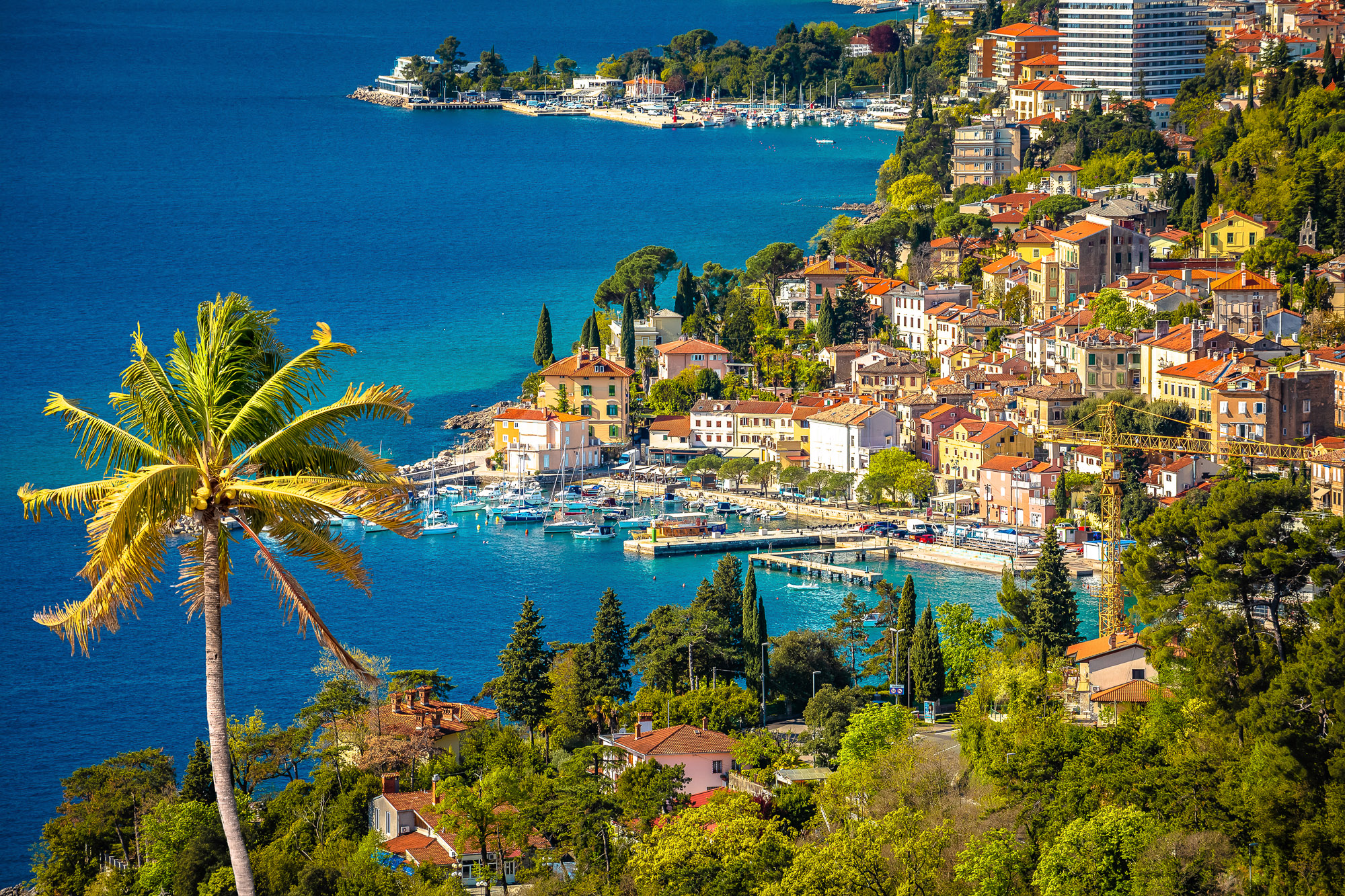
Opatija is Croatia’s oldest seaside resort, a town of Habsburg-era villas, grand hotels and subtropical gardens on the Kvarner coast, 20 minutes from Rijeka. Its main draw is the Lungomare, a 12 km seafront path to Volosko and Lovran. Add swimming platforms, spa hotels and mild winters, and it is a calm base for the Učka mountains, Krk and Istria.
What Opatija is like
Opatija feels more like a Central European spa town by the sea than a typical Croatian coastal village. There is no medieval walled centre. Instead, the town is a strip of 19th-century villas and hotels between the main road and the sea, with the slopes of Učka rising steeply behind. That mountain backdrop shelters the coast from cold winds, which is why the climate is mild and the gardens are full of laurel, palms and camellias.
The name comes from the Croatian word for abbey: the town grew around the small Benedictine abbey of St James, whose church still stands above the sea near Park Angiolina.
Who it suits: couples, older travellers, walkers, people looking for spa breaks and anyone who wants a comfortable, well-connected base. Who it suits less: travellers looking for nightlife, long sandy beaches or budget prices in peak season.
A short history of the resort
Modern Opatija began in 1844, when Iginio Scarpa, a merchant from Rijeka, built Villa Angiolina as a summer residence and named it after his late wife. When the railway from Vienna reached the coast, the railway company bought the villa and built the first hotels in the 1880s. Within a few years, Opatija was officially recognised as a health resort, and aristocrats, artists and wealthy families arrived from Vienna and Budapest for the winter season.
Many of the hotels and villas from that period are still in use, which gives the town its period look. Some have been restored beautifully; others are tired, so it pays to read recent reviews before booking.
Things to do in Opatija
Walk the Lungomare
The Lungomare, officially the Franz Joseph I promenade, runs about 12 km along the shore from Volosko through Opatija, Ičići and Ika to Lovran. It passes villa gardens, small coves, swimming platforms and little harbours, almost always within a few metres of the sea. It is flat and paved, though there are some steps and narrow sections.
- Short walk (about 30 minutes): central Opatija to Volosko, best at sunset, ending with dinner by the harbour.
- Half-day walk (3 to 4 hours): Volosko to Lovran, stopping to swim on the way, and taking the bus back.
Bring water and swimwear in summer; there is little shade on some sections in the middle of the day.
Park Angiolina and Villa Angiolina
Park Angiolina is the green heart of central Opatija, a 19th-century garden of exotic trees and shrubs collected by sea captains and gardeners, including the camellias that became the town’s symbol. They flower in late winter and early spring. Villa Angiolina, in the middle of the park, now houses the Croatian Museum of Tourism, which tells the story of how Opatija and the wider Adriatic became holiday destinations.
The Girl with the Seagull and the seafront
The bronze Girl with the Seagull (Djevojka s galebom) stands on a rock just off the promenade near the centre and is the town’s best-known image. Nearby is the Church of St James and its small terrace above the sea. Along the main street, a series of star plaques forms a Walk of Fame honouring Croatian personalities.
Volosko
Volosko, at the north end of the Lungomare, is a former fishing village of steep lanes, stone houses and a tiny harbour. It is where many locals go for dinner, with several well-regarded seafood restaurants around the harbour. It is busy on summer evenings, so book a table if you have your heart set on a particular place.
Lovran, Mošćenička Draga and Mošćenice
South of Opatija, the Riviera becomes quieter. Lovran has a small medieval core with an old town gate and the church of St George, and is known for its sweet chestnuts (maruni), celebrated with a festival in October. Further south, Medveja and Mošćenička Draga have the longest pebble beaches on the Riviera. Above Mošćenička Draga, the hilltop village of Mošćenice has a small old centre and a wide view over the Kvarner Gulf.
Beaches on the Opatija Riviera
Most of Opatija’s swimming spots are concrete platforms, rocky shelves and small pebble coves, with ladders into deep, clear water. They suit confident swimmers well but are less ideal for toddlers.
- Slatina – the main town beach, with platforms, sunbeds, cafés and easy access. Busy in summer.
- Tomaševac – a smaller beach west of the centre, within walking distance.
- Ičići – a pebble beach next to the marina, a short walk or bus ride from Opatija.
- Medveja – a long pebble beach between Lovran and Mošćenička Draga, good for families.
- Mošćenička Draga – the longest pebble beach on the Riviera, with shallower water and a small village behind it.
Parking near the beaches is limited and paid in summer. If you are staying in central Opatija, walk or take the local bus.
Wellness and spa breaks
Opatija was built on the idea of health tourism, and it still has many hotels with indoor pools, saunas and treatment centres. This makes it one of the few Croatian coastal towns that work well between November and March, when beach resorts elsewhere are largely closed. Off-season prices are noticeably lower, and some hotels offer wellness packages; compare what is included before booking.
Food and drink
The Opatija Riviera has some of the best restaurants in Kvarner, from simple konobas to ambitious modern kitchens. Local specialities to look for:
- Kvarner scampi – often served raw, grilled or “na buzaru” with garlic, wine and parsley.
- Fresh fish – grilled whole and priced by weight; ask what was caught that day.
- Lovran chestnuts (maruni) – roasted in autumn and used in desserts.
- Wild asparagus – picked on the slopes of Učka in spring, usually in a fritaja (omelette).
- Istrian influences – truffles, pršut (dry-cured ham), olive oil and Malvazija wine from nearby Istria.
Prices along the main promenade are higher than average. For better value, try the side streets, Volosko’s back lanes or the villages further down the Riviera.
Day trips from Opatija
Rijeka
Rijeka is about 20 minutes away by car or local bus. Spend half a day on the Korzo, at the morning fish market and up at Trsat Castle for the view over the port and the bay.
Učka Nature Park
Učka Nature Park rises directly behind the town. Drive up via the Poklon pass to the summit of Vojak, about 1,400 metres high, where a stone tower gives views over the islands and Istria. It takes about 40 minutes by car. Fit hikers can walk up from Opatija or Lovran on marked trails; allow most of a day.
Krk Island
Krk is about 45 minutes away by car over the Krk Bridge. For a day trip, combine the clifftop village of Vrbnik with a swim at Baška, or stay closer with Krk Town and Punat.
Istria
Opatija is on the doorstep of Istria. Through the Učka tunnel, the hill towns of central Istria are about an hour away. Motovun makes a good day trip for truffle country and views over the Mirna valley.
Cres
The car ferry to Cres leaves from Brestova, about 30 minutes south of Opatija, and the crossing is short. Cres Town and the hill village of Lubenice are possible in a long day, but the island is better with an overnight stay. Check the current ferry timetable on the Jadrolinija website.
Getting there and around
- By car – about 2 hours from Zagreb, about 1.5 hours from Pula and roughly 1.5 hours from Trieste. Parking in central Opatija is scarce and paid, so choose accommodation with parking if you drive.
- By air – the nearest airport is Rijeka Airport on Krk, about 45 minutes away. Pula, Trieste, Ljubljana and Zagreb airports are all within about 2 hours.
- By bus – frequent local buses connect Opatija with Rijeka and run along the Riviera to Lovran. Intercity buses stop in Opatija on routes to Zagreb and Istria.
- On foot – the centre, the Lungomare and Volosko are all walkable. Note that the town is built on a slope, so accommodation away from the sea can mean a steep walk.
Where to stay
- Central Opatija – for historic hotels, the parks, Slatina beach and easy buses. The best choice for a first visit without a car.
- Volosko – for character, restaurants and a village feel, with a 30-minute walk into Opatija.
- Ičići and Ika – quieter, close to the marina and pebble beaches.
- Lovran and Mošćenička Draga – for families and beach holidays, with longer pebble beaches and lower prices.
How long to stay and when to go
A day is enough to walk the Lungomare and see the centre. Two to three days lets you add Volosko, a swim and a trip up Učka. With five days or more, Opatija works as a base for Rijeka, Krk, Cres and Istria.
- Spring (April to June) – the best time for walking, with gardens in flower and fewer crowds.
- Summer (July and August) – warm sea and lively evenings, but busy and more expensive.
- Autumn (September and October) – warm sea in September, chestnut season in October, good hiking weather.
- Winter – mild by Croatian standards and quiet. Good for spa breaks and long walks, though the bora wind can be strong and cold.
Frequently asked questions
Is Opatija worth visiting?
Yes, especially if you like coastal walks, period architecture, good food and a calm atmosphere. It is less suited to travellers looking for nightlife or big sandy beaches.
Does Opatija have sandy beaches?
No. Beaches are concrete platforms, rocks and pebbles. The longest pebble beaches on the Riviera are at Medveja and Mošćenička Draga.
How long is the Lungomare in Opatija?
About 12 km, from Volosko to Lovran. Most people walk a section, such as Opatija to Volosko (about 30 minutes) or Opatija to Lovran (2 to 3 hours).
Opatija or Rijeka: where should I stay?
Stay in Opatija for a relaxed seaside base and Rijeka for city life, lower prices and better transport. They are only 20 minutes apart, so it is easy to visit both.
Can you visit Opatija without a car?
Yes. The town is walkable, and local buses run to Rijeka and Lovran. A car helps only for Učka, the islands and Istria.
Is Opatija good in winter?
It is one of the best Croatian coastal towns in winter thanks to its mild climate, spa hotels and year-round restaurants, though some seasonal businesses close.
Plan your trip
Planning a trip to Opatija?
Discover beaches, things to do, parking, food and practical travel information.