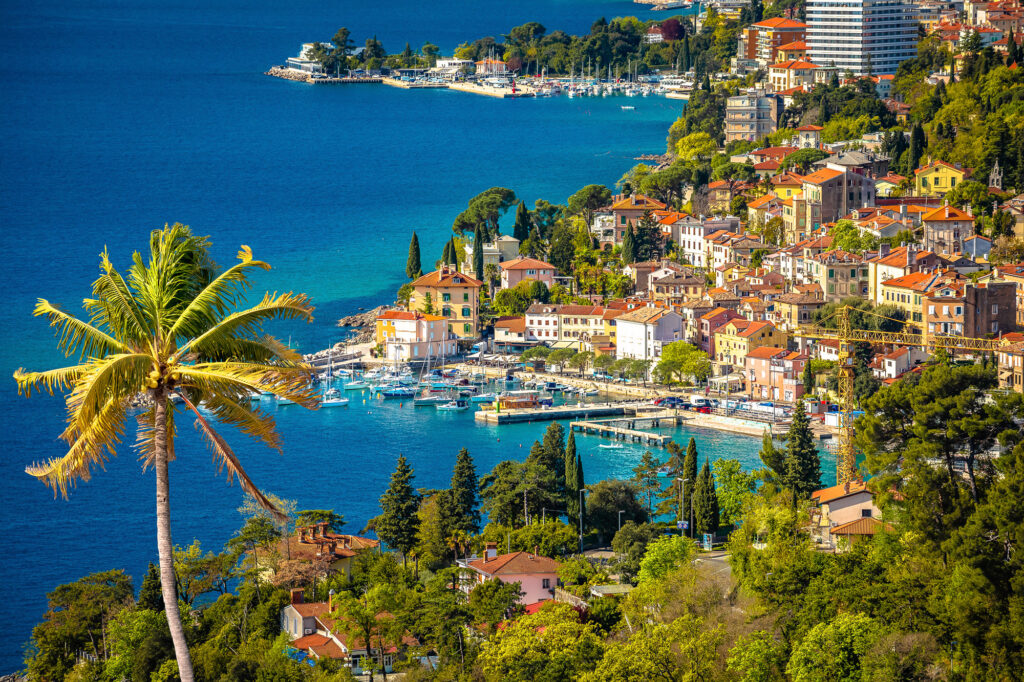
Rijeka is Croatia’s largest port and third-largest city, a working Adriatic city rather than a resort. Come for the Korzo promenade, the view from Trsat Castle, the morning fish market and a real local café scene, then use the city as a base for Opatija, Krk, the Učka mountains and the Kvarner islands.
Is Rijeka worth visiting?
Yes, if you know what to expect. Rijeka has no walled old town and no beach in the centre, and its waterfront is a busy commercial port with cranes and ferries. In return you get a lively, unpretentious city with Austro-Hungarian and Italian architecture, good-value food, few tour groups and excellent connections across the Kvarner region.
It suits travellers who enjoy cities with everyday life, history and a slightly rough edge. It suits less well anyone looking for a picture-postcard seaside town; for that, stay in Opatija, 20 minutes away, and visit Rijeka for a day.
A short history that explains the city
Rijeka has changed hands more often than almost any city on the Adriatic. It was a Habsburg port, then Hungary’s outlet to the sea, then the disputed Free State of Fiume after the First World War, then part of Italy, then Yugoslavia. Fiume, the Italian name, is still used by older Italian visitors.
That history shows in the mix of buildings: Habsburg palaces on the waterfront, Hungarian-era railway and port buildings, Italian modernism and socialist-era blocks. Industry mattered too. The first self-propelled torpedo was developed here in the 1860s, and the city’s shipyards and refinery shaped its working-class character. In 2020 Rijeka was a European Capital of Culture, which brought new life to several former industrial buildings.
Things to do in Rijeka
Walk the Korzo and the old town lanes
The Korzo is the pedestrian heart of the city, a wide street of 18th- and 19th-century façades, shops and cafés running parallel to the harbour. Its landmark is the City Clock Tower, built over the old sea gate to the city. Walk through the arch beneath it and you are in the small grid of lanes that was medieval Rijeka.
A good short loop from the tower:
- The Roman Gate (Stara vrata) – a plain stone arch, once the entrance to the Roman fortress of Tarsatica. The remains of its headquarters building are visible nearby.
- Church of the Assumption – with a bell tower that leans noticeably.
- St Vitus Cathedral – an unusual round baroque church on a small square uphill from the Korzo.
The whole loop takes about an hour at a gentle pace, including a coffee stop. Locals use the Korzo all day, so sitting at a café table here is part of the sightseeing.
Climb to Trsat
Trsat is the hill on the eastern side of the city, about 140 metres above the Rječina river. You can reach it on foot by the Trsat Steps (Trsatske stube), more than 500 steps that begin near the Titov trg bridge, or by city bus from the centre. Walking up takes 20 to 30 minutes; going down is much easier, so consider the bus up and the steps down.
At the top:
- Trsat Castle – a medieval fortress later owned by the Frankopan family and remodelled in the 19th century. The walls give the best views in Rijeka: the port, the Rječina canyon, Krk and the islands on a clear day. There is a café inside.
- Sanctuary of Our Lady of Trsat – one of Croatia’s main pilgrimage churches, linked to the legend that the house of the Virgin Mary rested here before it was carried to Loreto in Italy. The votive chapel, full of gifts left by sailors and pilgrims, is the most interesting part.
Visit the central market
Rijeka’s main market (Velika tržnica) sits between the Korzo and the harbour. Come before about 10am, when it is at its busiest. The fish hall, an early-20th-century building decorated with sculpted sea creatures, is the highlight; look for Kvarner scampi, squid, sardines and whatever the boats brought in that morning. The surrounding pavilions and stalls sell fruit, vegetables, cheese, cured meat and honey.
Museums and culture
- Maritime and History Museum of the Croatian Littoral – housed in the grand Governor’s Palace, covering the region’s seafaring and political history.
- The Benčić complex – a former industrial site turned cultural quarter, home to the City Museum in the restored Sugar Palace, the Museum of Modern and Contemporary Art and a library and children’s spaces.
- Torpedo heritage – the remains of the old torpedo factory and its launch station on the western waterfront are a reminder of the city’s industrial past. Check with the tourist office which sites are currently open to visitors.
Rijeka Carnival
If you are travelling in late winter, the Rijeka Carnival is one of the largest in Europe, with weeks of events ending in a big international parade on the Sunday before Ash Wednesday. Look out for the zvončari, bell-ringers from the surrounding villages who wear sheepskins and large masks to drive away winter. Book accommodation early for the parade weekend.
Beaches in and near Rijeka
There is no beach in the city centre, but there are several decent places to swim within a short bus ride:
- Kantrida – pebble beaches in the western suburbs near the swimming pool complex, popular with families.
- Pećine – on the eastern side below Trsat, with small concrete and pebble bathing areas used mainly by locals.
- Kostrena – a residential area just east of the city with a long coastal path and rocky coves, quieter than the city beaches.
For a proper beach day, most visitors head to the Opatija Riviera to the west or to Krk Island, both about 30 minutes away.
Food and drink
Rijeka eats like the rest of Kvarner: seafood from the bay, with influences from the mountains and from Italy and Central Europe. Names to look for:
- Kvarner scampi – prized for their sweetness, often cooked “na buzaru” (with garlic, wine, parsley and sometimes tomato).
- Fried small fish – such as girice and sardines, served simply with lemon in casual places near the market.
- Maneštra – a thick bean and vegetable soup, typical of the region’s home cooking.
- Game, mushrooms and venison – in the cooler months, from nearby Gorski Kotar.
- Wine – try žlahtina, the fresh white wine from Vrbnik on Krk.
The cheapest good meals are in the small eateries around the market and in the streets near the Korzo. For a more relaxed dinner with a sea view, many locals drive to Kostrena or along the coast towards Opatija.
Day trips from Rijeka
| Destination | Approx. drive | Why go |
|---|---|---|
| Opatija | 20 minutes | Villas, parks, the Lungomare coastal path |
| Krk Island | 30-50 minutes | Beaches, Vrbnik, Krk Town |
| Učka Nature Park | 45 minutes | Mountain views over Kvarner and Istria |
| Fužine | 35-40 minutes | Lakes, forests, cooler air in summer |
| Risnjak National Park | About 45 minutes | Mountain forest and hiking |
| Plitvice Lakes | About 2.5 hours | Croatia’s best-known national park |
Opatija and the Lungomare
Opatija is Rijeka’s elegant neighbour, a former Habsburg resort with villas, gardens and the Lungomare, a seafront path running about 12 km from Volosko to Lovran. Local buses run frequently from Rijeka.
Krk Island
Krk is joined to the mainland by a bridge, so no ferry is needed. In a day you can combine the clifftop village of Vrbnik, known for žlahtina wine, with Krk Town’s old centre or the long beach at Baška.
Učka and the mountains
The ridge of Učka Nature Park rises straight behind Opatija. Drive to the top at Vojak, about 1,400 metres, for views over the whole of Kvarner and its islands on a clear day. Inland, Fužine in Gorski Kotar has a lake, forest walks and cool air when the coast is hot.
Cres, Lošinj and Rab
Cres and Lošinj are better with at least one night. Drivers take the ferry from Brestova, about 40 minutes from Rijeka. Passenger catamarans also run from Rijeka’s harbour to several Kvarner islands; check the current timetable on the Jadrolinija website, as schedules change by season.
Getting to and around Rijeka
- By car – about 2 hours from Zagreb on the A6 motorway and about 1.5 hours from Pula through the Učka tunnel. Street parking in the centre is limited and paid; use a public garage and walk.
- By air – Rijeka Airport is on Krk Island near Omišalj, about 30 km from the city, with mainly seasonal flights. Zagreb and Pula airports are alternatives.
- By bus – frequent intercity buses connect Rijeka with Zagreb, Istria and the coast down to Split.
- By train – trains run to Zagreb, but they are slower than the bus.
- In the city – the centre is walkable. City buses serve Trsat, Kantrida and the suburbs, and regional buses run to Opatija and Kostrena.
Where to stay
- City centre – best for a short stay without a car, close to the Korzo, the market, the bus station and the harbour.
- Trsat – quieter and residential, with views, but uphill from everything.
- Kantrida, Pećine or Kostrena – closer to the sea, better for summer stays with swimming.
- Opatija – if you want a seaside base and plan to visit Rijeka for the day.
How long to stay and when to go
One full day covers the Korzo, the market, the old town and Trsat. Two days lets you add museums and a beach or Opatija. Three or four nights make sense if you are using Rijeka as a base for Krk, Učka and Gorski Kotar.
Rijeka is a year-round city. Spring and autumn are best for walking and day trips. Summer is hot, though the islands and mountains are close. February brings the Carnival, and winter is quiet but lived-in, with cafés and the market carrying on as normal.
Frequently asked questions
Is Rijeka worth visiting, or is Opatija better?
They are different. Rijeka is a real working city with markets, museums and local life. Opatija is a polished seaside resort. Many visitors stay in Opatija and spend a day in Rijeka, which works well as they are only 20 minutes apart.
How many days do you need in Rijeka?
One day is enough for the main sights. Plan two to four days if you want to use the city as a base for day trips around Kvarner.
Does Rijeka have beaches?
Not in the centre, but Kantrida, Pećine and Kostrena are a short bus ride away. For better beaches, go to the Opatija Riviera or Krk.
How do you get from Rijeka to Krk?
Drive over the Krk Bridge, about 30 minutes from the city, or take a regional bus from Rijeka bus station. No ferry is needed.
What is Rijeka known for?
Its port and shipbuilding, the Korzo promenade, Trsat Castle, the invention of the modern torpedo and one of Europe’s biggest carnivals.
Is Rijeka a good base without a car?
Yes. It has the best bus connections in Kvarner, with frequent services to Opatija, Krk and Zagreb, plus catamarans to some islands.
Plan your trip
Planning a trip to Rijeka?
Discover beaches, things to do, parking, food and practical travel information.