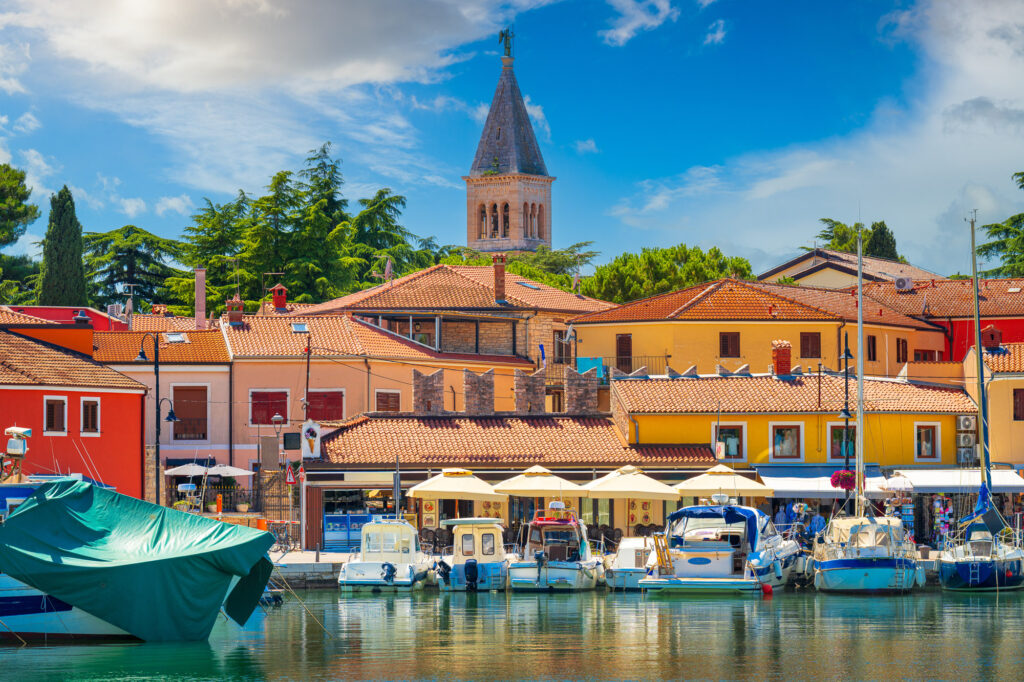
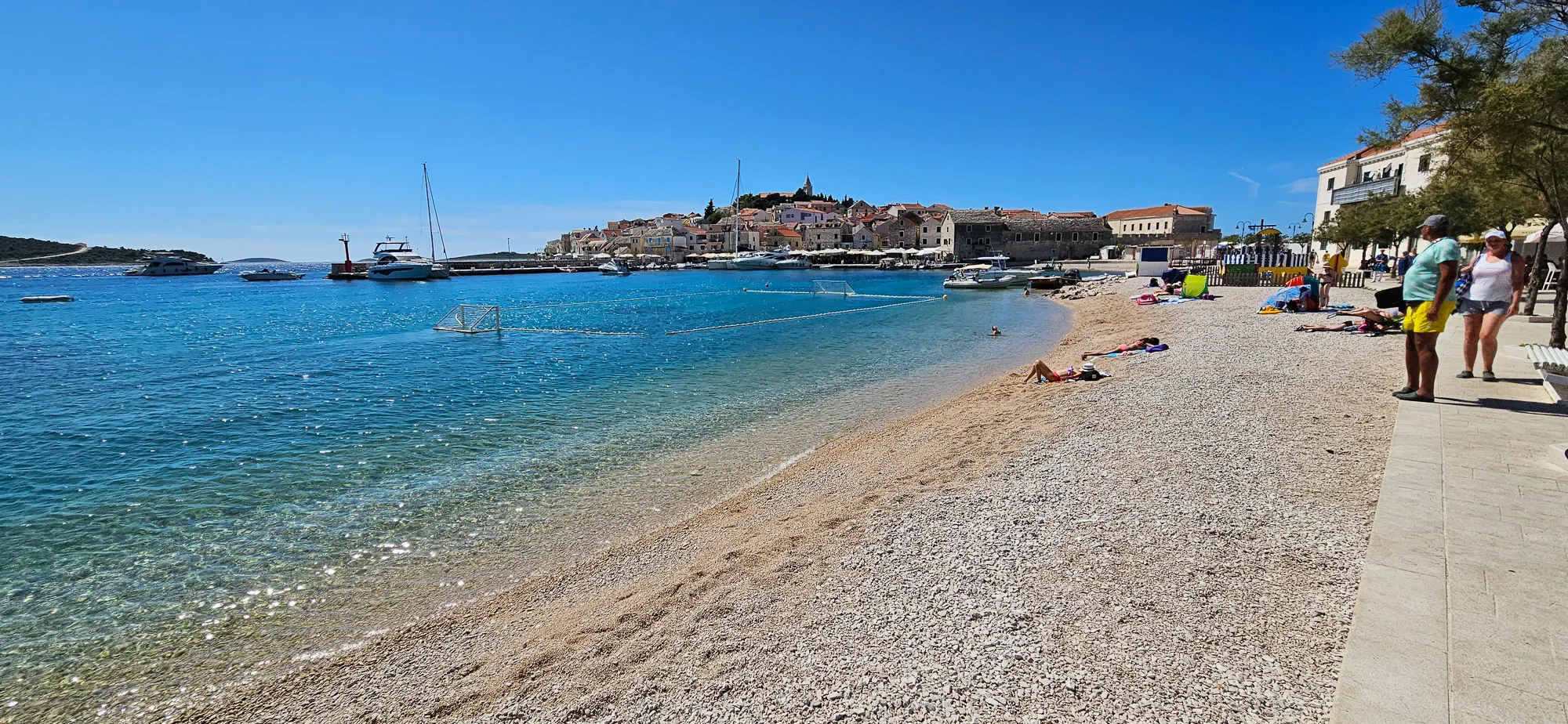
Istria is the heart-shaped peninsula in Croatia’s north-west, and it packs a remarkable amount into a small area: Venetian harbour towns like Rovinj, Roman Pula, the mosaics of Poreč, medieval hill towns such as Motovun and Grožnjan, and a countryside of vineyards, olive groves and truffle forests. Almost everything is within an hour’s drive, so you can see a hill town in the morning, have lunch in a rural konoba and still swim in the sea before sunset.
Where is Istria and what is it like?
Istria is the largest peninsula in the Adriatic. Most of it belongs to Croatia, with a small northern strip in Slovenia and the edge of Italy near Trieste. That border position shows everywhere: towns have both Croatian and Italian names, menus mix Italian and Central European influences, and you will hear Italian spoken in many coastal towns.
Locals often divide the peninsula by soil colour:
- “Red Istria” – the low, red-soiled west and south coast, with the main resorts: Umag, Novigrad, Poreč, Vrsar, Rovinj and Pula.
- “Grey Istria” – the hilly, greener interior around Pazin, Motovun, Grožnjan and Buzet, with the Mirna valley below.
- “White Istria” – the bare limestone uplands towards Učka mountain in the north-east.
The east coast, around Rabac and Labin, faces the Kvarner Gulf and is quieter than the west.
Best places to visit in Istria
Rovinj
Rovinj is the town most people picture when they think of Istria: pastel houses rising straight out of the sea, crowned by the Church of St Euphemia and its Venetian-style bell tower. The old town was once an island and is still almost entirely pedestrian. Walk up Grisia street to the church, then down to the harbour for the classic view from the waterfront.
South of town, Golden Cape (Zlatni rt) forest park has shaded paths and rocky swimming spots, and it is flat enough for an easy walk or bike ride. Boats go from the harbour to Red Island and other small islands offshore.
Who it suits: couples, photographers, anyone wanting atmosphere and good restaurants. Downside: it is very busy in July and August, parking near the centre is limited and paid, and accommodation is among the most expensive in Istria.
Pula
Pula is Istria’s largest city and the best place for Roman history. The amphitheatre (Arena), built in the 1st century AD, is one of the best-preserved in the world and still hosts concerts and the Pula Film Festival in summer. In the compact old centre you will find the Temple of Augustus on the Roman forum, the Arch of the Sergii and a Venetian fortress (Kaštel) with views over the harbour. At night the shipyard cranes are lit up in changing colours.
Pula is also the gateway to the southern tip of the peninsula: Medulin, Premantura and the Kamenjak protected landscape, a wild cape of rocky coves and clear water about 20 minutes’ drive from the city. In summer there is a charge for cars entering Kamenjak and the dirt roads are dusty, so go early.
Who it suits: history lovers and travellers who want a real city with good transport. Downside: the city itself is more workaday than pretty outside the centre.
Poreč
Poreč is the main resort of western Istria, with the largest choice of hotels and campsites. Its highlight is the Euphrasian Basilica, a UNESCO World Heritage Site with glittering 6th-century Byzantine mosaics in the apse. The old town keeps its Roman street plan, with the Decumanus running down the middle of the peninsula. Nearby, Baredine Cave makes a good short trip on a hot or rainy day.
Who it suits: families and beach holidays with sightseeing on the side. Downside: the coast around town is dominated by large resort complexes.
Vrsar and Lim Bay
Vrsar is a small hilltop town above a marina, about 15 minutes south of Poreč. Just beyond it, Lim Bay is a narrow, fjord-like inlet around 10 km long, lined with forested slopes. Boat trips run into the bay from Vrsar, Poreč and Rovinj in season, and the restaurants at the head of the inlet are known for oysters and mussels farmed in its waters. There is a viewpoint by the road between Vrsar and Rovinj.
Novigrad and Umag
Novigrad sits on a small peninsula with town walls, a little harbour and a relaxed atmosphere that suits people wanting something quieter than Rovinj. Umag, further north and close to the Slovenian border, is a practical base for drivers coming from Italy or Slovenia and hosts an international tennis tournament each July. Both have a long coastline of camps and pebble or rocky beaches.
Fažana and the Brijuni Islands
Fažana is a small fishing town just north of Pula, best known as the departure point for boats to Brijuni National Park. The islands were once Tito’s summer residence and now combine Roman ruins, parkland, a safari park with exotic animals and dinosaur footprints. Visits are usually by the national park’s own boat and guided tour; check times and booking in advance in summer.
Inland Istria and the hill towns
The most common mistake visitors make is never leaving the coast. Inland Istria is where the peninsula feels most distinctive: hilltop towns behind medieval walls, valleys full of mist in the morning, and small family restaurants serving pasta with truffles.
Motovun
Motovun sits on a hill above the Mirna valley, about 45 minutes from Rovinj or 30 minutes from Poreč. You can walk the top of the old walls for views over the forest where truffles are found. Cars must be left in the car parks below, and the walk up is steep. In late July the Motovun Film Festival fills the town.
Grožnjan
Grožnjan is a quiet stone town about 20 minutes from Motovun, known for galleries, studios and summer music courses. It is at its best in the late afternoon, when the day visitors leave.
Hum and the Glagolitic Alley
Hum calls itself the smallest town in the world: a handful of houses inside walls. The road from Roč to Hum is lined with stone monuments known as the Glagolitic Alley, dedicated to the old Croatian script. Try biska, a local mistletoe brandy.
Pazin
Pazin is the geographical centre of Istria. Its castle stands on the edge of a deep chasm where the Pazinčica river disappears underground, a scene that inspired Jules Verne. A zip line crosses the gorge, and a footpath leads down into it.
Bale and Dvigrad
Bale is a compact medieval village between Rovinj and Pula, an easy stop on that drive. A short detour inland near Kanfanar brings you to Dvigrad, the atmospheric ruins of an abandoned walled town in the woods.
Driving tip: roads inland are good but narrow and winding. Combine two or three hill towns in a day rather than trying to see them all.
Best beaches in Istria
Istria has very clear water but few sandy beaches. Expect pebbles, flat rocks and concrete sunbathing platforms, often shaded by pine trees. Water shoes are worth packing. Good areas include:
- Golden Cape, Rovinj – forest-backed rocks and coves within walking distance of town.
- Kamenjak, Premantura – wild coves and cliffs at the southern tip; bring shade and water.
- Medulin – shallow, gently shelving water that suits small children.
- Around Poreč and Vrsar – resort beaches with facilities, plus rocky spots between them.
- Rabac – pebble bays on the east coast below the hill town of Labin.
Food and wine in Istria
Istrian food is one of the best reasons to go inland. Look out for:
- Truffles – black truffles for much of the year, and the prized white truffle from roughly autumn to early winter, served shaved over pasta or eggs.
- Fuži and pljukanci – the two classic hand-made Istrian pastas.
- Istrian pršut – air-dried ham, usually served with sheep’s cheese.
- Maneštra – a thick bean and vegetable soup.
- Boškarin – the native long-horned Istrian ox, used for carpaccio and stews.
- Fritaja – an omelette with wild asparagus in spring.
- Lim Bay oysters and mussels, and fresh fish along the coast.
- Olive oil – Istria produces some of the most highly rated oils in Europe; many family estates offer tastings.
The main wines are Malvazija Istarska, a fresh white, and Teran, a deep, acidic red. Many wineries around Buje, Momjan, Motovun, Poreč and Vodnjan welcome visitors, but it is best to contact them first, especially outside summer.
Things to do in Istria
- Watch sunset from the waterfront below Rovinj’s old town.
- Stand inside Pula’s Roman Arena, and see a concert there if you are visiting in summer.
- See the mosaics of the Euphrasian Basilica in Poreč.
- Walk the walls of Motovun and have truffle pasta in the area.
- Cycle a stretch of the Parenzana, a former narrow-gauge railway turned cycling and walking route through the hills near Motovun and Grožnjan.
- Take a boat into Lim Bay.
- Spend a day swimming at Kamenjak.
- Visit Brijuni National Park from Fažana.
- Look down into the Pazin chasm.
- Drive up Učka for views over Istria and the Kvarner Gulf.
Getting to and around Istria
Arriving
- By air: Pula Airport is the main gateway, with many seasonal flights. Trieste, Ljubljana, Venice, Rijeka and Zagreb are alternatives with longer drives.
- By car: the Istrian Y motorway (tolled) links Umag, Poreč, Rovinj, Pula and the Učka tunnel to Rijeka. Zagreb to Rovinj or Pula takes around 3 hours.
- By boat: seasonal fast boats link Venice with several Istrian ports. Routes change by year, so check with the operators.
- By bus: regular buses run from Zagreb, Rijeka, Ljubljana and Trieste to the main coastal towns.
Getting around
A car is the easiest way to see Istria properly. Approximate drive times: Rovinj to Pula about 40 minutes, Rovinj to Poreč about 40 minutes, Poreč to Motovun about 30 minutes, Pula to Motovun about an hour, Umag to Poreč about 35 minutes.
Without a car, base yourself in Rovinj, Pula or Poreč, which have the best bus links, and use excursions or taxis for the interior. Buses to hill towns are infrequent, especially at weekends and outside summer. A slow regional railway runs north from Pula through Pazin, but it is not useful for the coastal resorts.
Where to stay in Istria
| Base | Best for | Consider |
|---|---|---|
| Rovinj | Atmosphere, restaurants, central location | Crowds and higher prices |
| Pula | Roman sights, transport, southern beaches | More city than resort |
| Poreč / Vrsar | Families, resorts, Lim Bay | Large hotel complexes |
| Novigrad / Umag | Quieter coast, arriving from Italy or Slovenia | Far from southern Istria |
| Inland (Motovun, Grožnjan, Buzet area) | Food, wine, peace, villas with pools | Car essential; 30–45 minutes to the sea |
For a week or more, two bases work well: a few nights on the coast and a few in a rural stone house or agritourism inland.
Best time to visit Istria
- April to June: green countryside, wild asparagus, comfortable cycling and walking; the sea is warm enough for most from June.
- July and August: hot, busy and lively, with festivals and concerts; book early.
- September: warm sea, grape harvest and fewer crowds – arguably the best month.
- October and November: white truffle season and olive harvest; many coastal hotels close, but inland restaurants are at their best.
- Winter: quiet and often grey; some restaurants and hotels close.
For events and seasonal news, check the official Istria tourist board website.
How many days do you need in Istria?
- 3 days: Rovinj, Pula and one day for Motovun and Grožnjan.
- 5–7 days: add Poreč, Lim Bay, Kamenjak or Brijuni, and a slower day inland.
- 10 days: enough for two bases, wineries, cycling the Parenzana and the quieter east coast.
Sample five-day route
- Day 1: Rovinj old town and Golden Cape.
- Day 2: Bale on the way to Pula; the Arena and old centre, then a swim at Kamenjak.
- Day 3: Brijuni from Fažana, or a beach day around Medulin.
- Day 4: Inland – Pazin, Motovun and Grožnjan, with lunch at a konoba.
- Day 5: Lim Bay viewpoint or boat trip, then Poreč and the Euphrasian Basilica.
Frequently asked questions
Is Rovinj or Pula a better base in Istria?
Rovinj is prettier and more central for the west coast and interior; Pula is better for Roman sights, transport links and the southern beaches. If you want one base and a car, Rovinj is the more balanced choice.
Do you need a car in Istria?
Not for the main coastal towns, which are linked by bus. But to see the hill towns, wineries and quieter beaches, a car makes a big difference.
Does Istria have sandy beaches?
Very few. Most beaches are pebble, rock or concrete platforms with very clear water. Medulin has some of the shallowest, most child-friendly water.
When is truffle season in Istria?
Black truffles are available for much of the year, while the more prized white truffle is found from roughly autumn into early winter, when inland restaurants put it on the menu.
How long does it take to drive across Istria?
Distances are short. Umag to Pula, almost the full length of the west coast, takes roughly an hour by motorway, and most hill towns are 30–60 minutes from the coast.
Is Istria expensive?
It is one of the pricier parts of Croatia in summer, especially Rovinj. Inland stays, shoulder-season travel and eating in konobas rather than waterfront restaurants keep costs down.
Plan your trip
Planning a trip to Istria?
Discover beaches, things to do, parking, food and practical travel information.