Krk is the easiest Croatian island to reach: a toll-free bridge links it to the mainland about 30 minutes from Rijeka, so you can drive on without booking a ferry. It packs a walled old town (Krk Town), a long beach under bare mountains (Baška), a clifftop wine village (Vrbnik) and a monastery islet (Košljun) into an island you can cross in under an hour.
Is Krk the right island for you?
Krk is one of the two largest islands in the Adriatic, about 40 km from north to south, and one of the most developed for tourism. Croatians call it the “golden island”, and it is in the Kvarner region, the northern part of the Croatian coast.
Krk suits: families, road-trippers, first-time visitors to Croatia, travellers arriving from Central Europe by car, and anyone who wants plenty of choice in beaches, villages and food within short drives.
Krk suits less: travellers looking for a remote, untouched island. The north of the island has an airport, an oil terminal and a busy main road in summer, and the bigger resorts are crowded in July and August. For a wilder feel, look at neighbouring Cres instead.
The island at a glance
| Place | Character | Best for |
|---|---|---|
| Krk Town | Walled old town, harbour, cathedral | First-time visitors, couples, sightseeing |
| Baška | Long pebble beach, mountain backdrop | Beach holidays, families, hiking |
| Vrbnik | Clifftop village, wine cellars | Food and wine, atmosphere |
| Punat | Sheltered bay, marina, Košljun | Boating, families, calm water |
| Malinska and Njivice | Resort villages on the west coast | Easy family stays, sunsets |
| Omišalj | Hilltop old village near the bridge | Short stays, quick access |
Krk Town
Krk Town is the island’s historic capital, built on the site of the Roman town of Curicum, and is the best all-round base. Its old centre is still partly enclosed by walls, with narrow stone lanes leading up from the harbour.
What to see on a walk of an hour or two:
- The cathedral – a Romanesque church with an attached church of St Quirinus, the town’s patron saint, and a separate bell tower.
- The Frankopan castle (Kaštel) – fortifications on Kamplin square by the sea. The powerful Frankopan noble family, later important across Croatia, began as the lords of Krk. In summer the castle courtyard is used for concerts and events.
- The town gates and walls – including the sea gate on the waterfront.
- The harbour promenade – lined with cafés and restaurants, and the departure point for boat trips.
There are town beaches and swimming spots within walking distance of the centre, and campsites and hotels around the bay. Krk Town is about 30 minutes from the bridge and 20 to 30 minutes from Baška, Vrbnik and Punat, which makes it practical for exploring.
Baška and the south
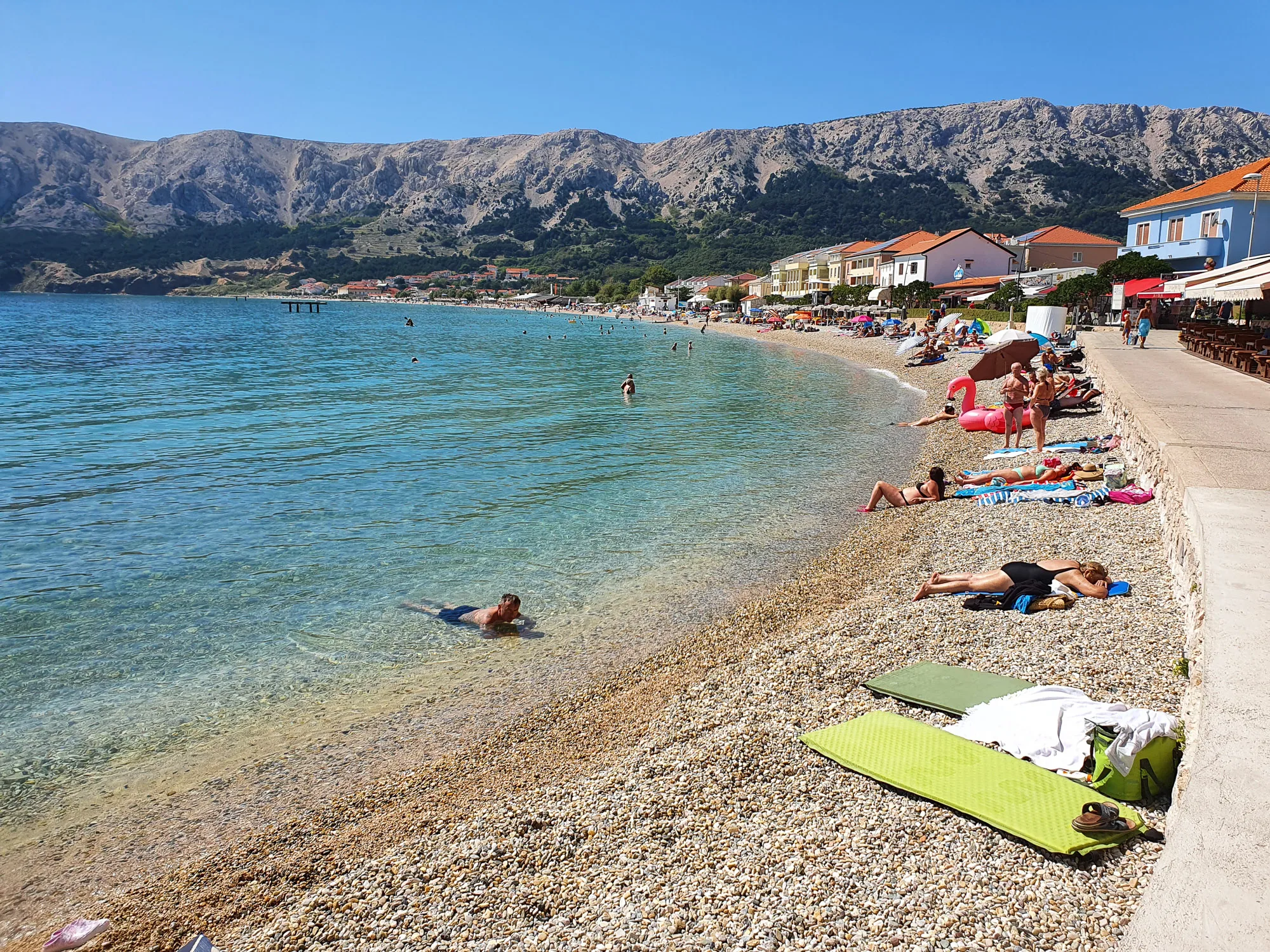
Baška is at the southern end of the island, in a valley that ends in a long curved pebble beach, Vela plaža, nearly 2 km long. Bare limestone hills rise behind it, and on a clear day you can see the islands of Prvić and Rab across the water. It is the classic Krk beach holiday and the busiest place on the island in summer.
The Baška tablet and the Glagolitic heritage
The valley above Baška is one of the most important places in Croatian history. In the small church of St Lucy in Jurandvor, a stone slab known as the Baška tablet (Bašćanska ploča) was found. Dating from around 1100, it is one of the oldest surviving texts in the Croatian language, written in the Glagolitic script. The original is kept in Zagreb, but a copy stands in the church, which is worth a short stop on the way into Baška. Look out also for stone sculptures of Glagolitic letters along the roads of the valley.
Hiking above Baška
The hills around Baška are crossed by marked trails. The most popular leads up to the stony plateau known as the Moon Plateau, with wide views over the Kvarner islands; another climbs to Obzova, the highest point on Krk at just under 570 metres. There is almost no shade, so start early, carry plenty of water and wear proper footwear rather than beach shoes.
Vrbnik
Vrbnik sits on a rock about 50 metres above the sea on the east coast, facing the mainland mountains. It is a compact village of stone houses and steep lanes, including Klančić, often called one of the narrowest streets in the world. The village is quiet in the evening once day visitors leave.
Vrbnik is the home of žlahtina, Krk’s fresh, light white wine, grown in the fertile Vrbnik field below the village. Several family wineries and konobas offer tastings; it is worth asking at your accommodation which ones are open when you visit. Combine a tasting with a plate of Krk pršut and sheep’s cheese.
Below the village there is a small harbour and pebble beach. Parking is outside the old centre, and you walk in.
Punat, Košljun and Stara Baška
Punat sits on an almost enclosed bay on the south-west coast, with calm water and a large, long-established marina. It is a relaxed, family-friendly base with a long seafront promenade.
In the middle of Punat bay lies Košljun, a small wooded islet with a Franciscan monastery that has been home to friars for centuries. Small boats run across from Punat’s waterfront in summer and the crossing takes only a few minutes. On the islet you can visit the monastery church and its small museum and walk the shaded paths. Dress modestly, with shoulders and knees covered.
South of Punat, a narrow road climbs over bare, stony hills to Stara Baška, a small settlement of campsites and holiday homes around clear coves. The landscape is stark and beautiful, but the road is narrow, and the area gets very busy in peak season.
Malinska, Njivice and Omišalj
The north-west coast is greener and gentler, with pine woods running down to the sea. Malinska and Njivice are holiday villages with hotels, apartments, promenades and family-friendly pebble beaches. They face west, so evenings bring good sunsets, and they are close to the bridge and Rijeka Airport.
Omišalj is one of the oldest settlements on Krk, an old hilltop village above a bay. Below it are the ruins of Fulfinum and Mirine, a Roman town and an early Christian basilica. Omišalj is also close to the industrial installations in the north of the island, so it is better for short stays than for a seaside holiday.
Dobrinj, Šilo and the east
The east side of the island is quieter. Dobrinj is a small hilltop village with a church square and views over the countryside, Šilo is a seaside village facing the mainland, and Soline Bay near Čižići is known for its shallow water and healing mud. The Biserujka cave near Rudine is a small show cave that makes a short, cool stop on a hot day.
Best beaches on Krk
- Vela plaža, Baška – the island’s best-known beach: long, pebbly and busy in summer, with all facilities.
- Coves near Baška – smaller beaches reached on foot or by taxi boat from Baška harbour, quieter than the main beach.
- Stara Baška coves – clear water and a stark rocky landscape.
- Punat bay – calm, shallow water good for small children.
- Malinska and Njivice – pebble beaches shaded by pine woods.
- Soline Bay – shallow, warm water and mud baths.
Most beaches are pebble or rock. Water shoes are useful, especially for children. In July and August, arrive early at the popular beaches for parking and space.
Food and drink
- Šurlice – Krk’s signature handmade pasta, rolled into tubes and usually served with lamb or beef goulash or with scampi.
- Krk pršut – the island’s dry-cured ham, seasoned with salt, pepper and herbs.
- Lamb and sheep’s cheese – from flocks grazing the stony pastures of the island.
- Kvarner scampi and fresh fish – in harbour restaurants in Krk Town, Baška and Vrbnik.
- Žlahtina – the local white wine, best tasted in Vrbnik.
- Olive oil and honey – often sold by small producers along the roads and in village shops.
Getting to Krk
- By car – the Krk Bridge is about 30 minutes from Rijeka, about 2 hours 15 minutes from Zagreb and roughly 2 hours from Ljubljana. Crossing the bridge is free.
- By air – Rijeka Airport is on Krk itself, near Omišalj, with mainly seasonal flights from European cities.
- By bus – regular buses run from Rijeka and Zagreb to the main towns on the island. Check the current timetable before travelling, especially outside the summer.
- Onward by ferry – car ferries run from Valbiska on Krk’s west coast to Merag on Cres and to Lopar on Rab. Check schedules on the Jadrolinija website.
On summer weekends, especially Saturdays when holiday rentals change over, expect queues on the main road between the bridge and Krk Town. Travel early in the morning if you can.
Getting around the island
A car is the most practical way to see Krk, as the main sights are spread out and buses between villages are infrequent. Main roads are good, but village roads and the route to Stara Baška are narrow. Parking in Krk Town, Baška and Vrbnik is paid in summer, and it can be hard to find a space at midday.
Without a car, base yourself in Krk Town or Baška and use local buses and boat trips. Cycling is popular in spring and autumn, but the island is hillier than it looks and very hot in summer.
Where to stay
- Krk Town – best first base: central, historic and with restaurants within walking distance.
- Baška – for a beach holiday and hiking, but further from everything else.
- Vrbnik – small and atmospheric, best for couples and wine lovers.
- Punat – calm and family-friendly, good for sailors.
- Malinska and Njivice – convenient family resorts, quick to reach from the bridge.
Suggested itineraries
Day trip from Rijeka or Opatija
Drive over the bridge to Vrbnik for a morning walk and a coffee, continue to Krk Town for lunch and a walk round the old town, then finish with a swim in Baška or Punat. It is a full day; leave Košljun for another time. Rijeka is about 30 minutes from the bridge.
Three days
- Day 1 – Krk Town in the morning, Punat and Košljun in the afternoon.
- Day 2 – Baška: the Baška tablet in Jurandvor, a morning hike and an afternoon on the beach.
- Day 3 – Vrbnik and a wine tasting, then Dobrinj or Malinska for sunset.
With a week, add a ferry day trip to Cres or Rab, a lazy beach day and a trip back to the mainland for Opatija or Rijeka.
Best time to visit
- May and June – warm, green and much quieter. The sea is cool until early June.
- July and August – hot, crowded and lively, with the warmest sea. Book accommodation and boat trips early.
- September – often the best month: warm sea, fewer people and grape harvest in Vrbnik.
- October to April – very quiet. Many restaurants and hotels close, but the island is good for walking and cycling. The bora wind can be strong and cold, and it sometimes affects bridge traffic.
Frequently asked questions
Do you need a ferry to get to Krk?
No. Krk is connected to the mainland by the Krk Bridge, and crossing it is free. Ferries only run from Krk onward to Cres and Rab.
Where is the best place to stay on Krk?
Krk Town is the best all-round base for a first visit. Choose Baška for a beach holiday, Vrbnik for atmosphere and wine, and Punat or Malinska for family stays.
What is the best beach on Krk?
Vela plaža in Baška is the best-known, a long pebble beach with mountain views. For calmer water, try Punat bay; for clear coves, Stara Baška.
How many days do you need on Krk?
One day gives you a taste. Three days covers Krk Town, Baška, Vrbnik and Košljun comfortably. A week allows beach days and trips to Cres or Rab.
Is Krk good for families?
Yes. It is easy to reach, has shallow bays in Punat and Soline, family resorts in Malinska and Njivice, and plenty of campsites and apartments.
Can you visit Krk without a car?
Yes, but it takes more planning. Buses run from Rijeka and Zagreb to the main towns, and Krk Town or Baška make good car-free bases. Smaller villages are harder to reach.
Plan your trip
Planning a trip to Krk Island?
Discover beaches, things to do, parking, food and practical travel information.